Cinematic
Neon night chase
“Low tracking camera follows a rider through rain-soaked neon streets, reflections streaking across the pavement.”
Explore MiniMax H3 Max for text-to-video, image-to-video, native synchronized audio, and first-to-last-frame control — with stronger prompt adherence and faster inference.
Examples
Give MiniMax H3 Max concrete camera language, physical action, atmosphere, and audio direction to get more intentional results.
“Low tracking camera follows a rider through rain-soaked neon streets, reflections streaking across the pavement.”
“A polished product rotates slowly on black glass while cool rim light sweeps across the surface.”
“Intimate close-up, subtle handheld motion, natural blinking and expressive dialogue with room ambience.”
“The portrait comes alive with a slow push-in, wind moving through hair and soft environmental sound.”
Rankings
Independent boards put H3 Max first for image-to-video quality, while a 5-second 768p clip still comes back in under 3 seconds.
Figures as published by fal, August 25, 2026.
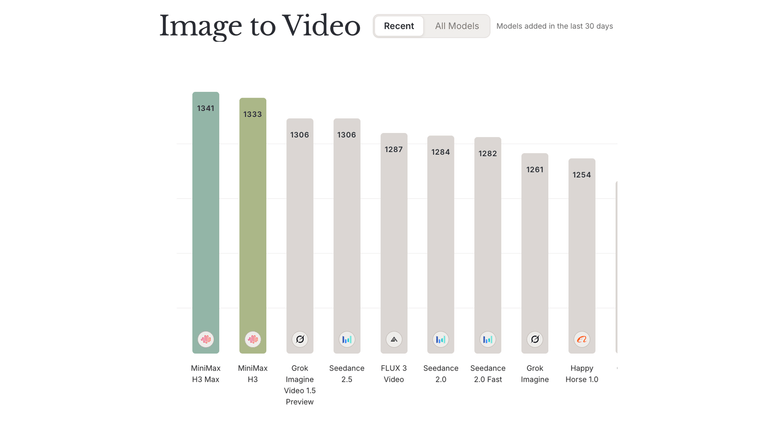
Design Arena scores MiniMax H3 Max at an Elo of 1,341 on its image-to-video board, ahead of base MiniMax H3 at 1,333 and every other model listed. The same board puts it first with and without audio, and notes MiniMax H3 quality at more than 50× the speed of the official H3 endpoint.
See the full board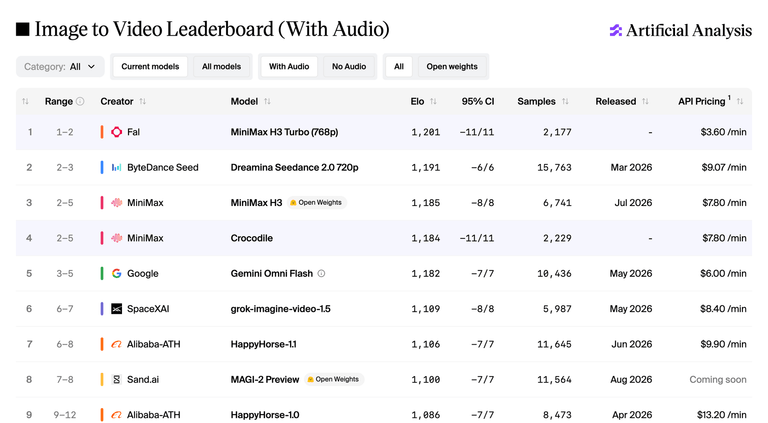
Artificial Analysis ranks MiniMax H3 Max first with audio, at an Elo of 1,201 with a 95% confidence interval of ±11 over 2,177 samples. It is listed there under its internal name, MiniMax H3 Turbo (768p).
See the full boardCapabilities
MiniMax H3 Max brings the core video workflows into one focused model: directed text-to-video, image animation, first-to-last-frame transitions, and synchronized audio generation.
Describe the subject, action, camera move, environment, and sound in natural language. H3 Max is tuned to follow detailed creative direction more closely.
Start from an image and direct how the scene should move. The generated output follows the source image aspect ratio.
Provide a starting image and an optional ending frame to guide a transition between two visual states.
H3 Max keeps MiniMax H3's unified audio-video generation capability, so sound can be part of the scene rather than a separate afterthought.
Prompt formula
MiniMax H3 Max is specifically post-trained for prompt adherence. Give it a shot structure it can execute.
A silver concept car accelerates through a rain-soaked downtown tunnel at night. Low tracking camera locked to the front quarter panel, water spraying from the tires, neon signage streaking across the bodywork. Cool blue lighting with warm red reflections. Deep engine note, tire hiss, distant city ambience. End on a clean hero profile as the car exits the tunnel.
Describe movement through time, not only appearance.
Tracking, push-in, crane, orbit, handheld.
Dialogue, ambience, SFX, and music cues.
Same family, different jobs. MiniMax H3 Max trades the resolution ceiling for speed and prompt adherence.
If you are iterating on a shot, MiniMax H3 Max turns the wait into something close to instant and holds the prompt better. Switch to standard MiniMax H3 the moment you need 2K output, reference-driven generation or precise editing.
FAQ
Speed, specs, and how it differs from the model it was post-trained from.
MiniMax H3 Max is a faster, more prompt-faithful version of MiniMax H3 for creating short videos. You describe a shot in text or start from an image, and it returns a 5–15 second clip with sound already in sync — typically a 5-second 768p video in under 3 seconds. Use it when you want to iterate quickly without losing the look, camera move, or audio you asked for.
MiniMax H3 Max renders a 5-second clip at 768p in under 3 seconds, which is faster than real time. That is roughly 35x the throughput of the official MiniMax H3 endpoint, and on average 15x faster than models of comparable quality. Actual denoising time lands at around 2.5 seconds for a 5-second 768p generation, and longer durations scale from there, so a 15-second clip takes about 15 seconds.
MiniMax H3 Max is first on both public image-to-video boards. Design Arena scores it at an Elo of 1341, ahead of base MiniMax H3 at 1333 and every other model on that board. Artificial Analysis ranks it first on its image-to-video leaderboard with audio, at an Elo of 1201 with a 95% confidence interval of ±11 over 2,177 samples. fal's own head-to-head human preference studies against twelve leading video models put it first on overall quality, prompt understanding and aesthetics. Information updated as of August 25, 2026.
MiniMax H3 Max generates at 480p or 768p, with 768p the default and the resolution it is tuned around. At 16:9 that is 1344×768 at 24 FPS. Durations run from 5 to 15 seconds. Text to video covers 21:9, 16:9, 4:3, 1:1, 3:4 and 9:16, and on image to video the output follows the aspect ratio of the image you pass in. For 2K output, use standard MiniMax H3 instead.
MiniMax H3 Max is fal's post-trained variant, tuned for prompt adherence, audio-visual quality and aesthetics, and co-optimized with fal's inference stack so a 5-second 768p clip renders in under 3 seconds. Standard MiniMax H3 is a separate frontier model with its own endpoints: it generates at 2K and adds reference to video and video editing. Reach for H3 Max when you want speed and prompt adherence, and standard H3 when you need 2K or the reference and editing endpoints.
Stay at 768p, generate 5 to 10 seconds, and leave prompt expansion on balanced. Balanced decides per request how much to rewrite your prompt, which keeps end-to-end time close to render time, while fast returns in about a second and quality can spend up to 30 seconds on the rewrite alone. Describe the sound as well as the shot, since audio is generated in the same pass as the picture.
Two are live: text to video and image to video, which also handles first-to-last keyframes when you supply a closing image. Reference to video is on the way. Until it arrives, reference-driven generation with up to 9 images, 3 videos and 3 audio clips is available on standard MiniMax H3.
Yes. Videos you generate here can be used in commercial projects. Check the terms of service for full details on usage rights and licensing.